
Search products by name
Search medicines by name
0
0 item
৳ 0.00
Your Complete HealthCare Solution - Right Here


10657
info@shukhee.com
Telecom Bhaban (Level- 12), 53/1 Box Nagar, Zoo Road, Dhaka-1216.
৳ 0.00
10657
info@shukhee.com
Telecom Bhaban (Level- 12), 53/1 Box Nagar, Zoo Road, Dhaka-1216.


Quantity:

Products

Payment

Delivery
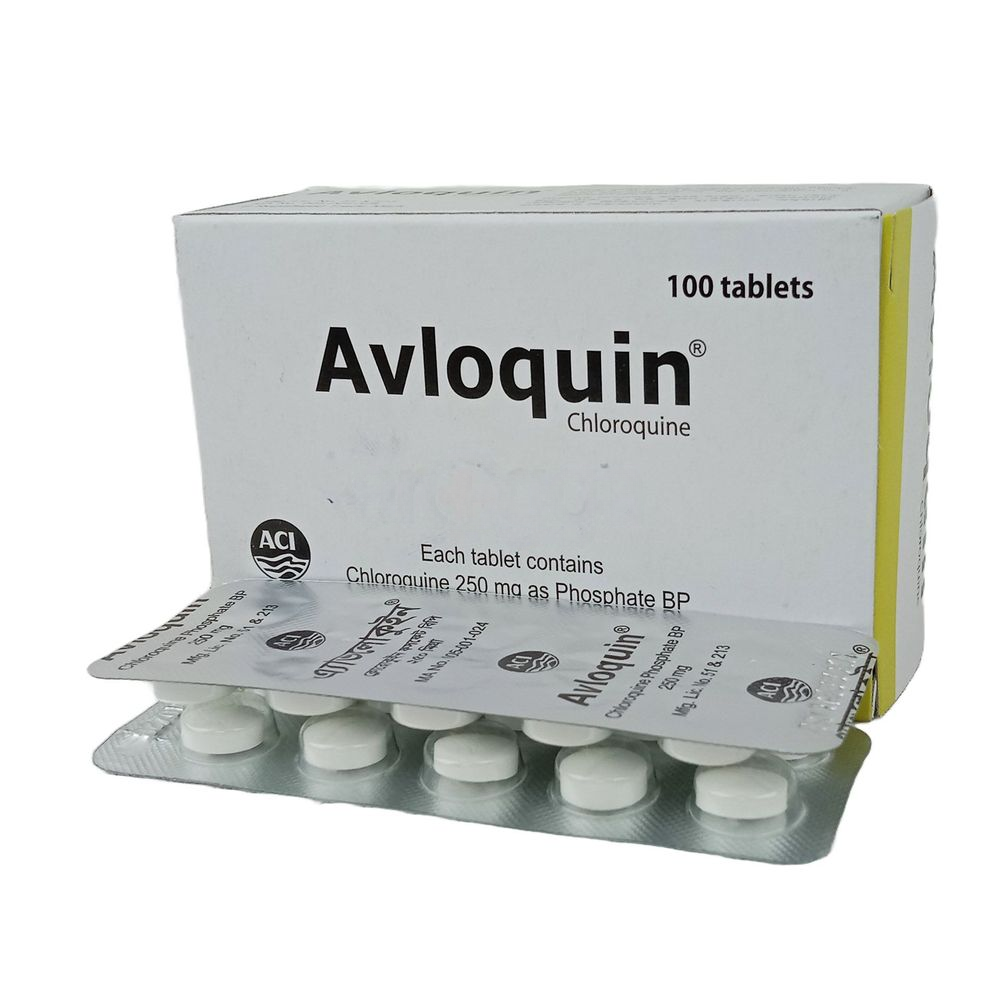
Rheumatoid arthritis, Malaria, Systemic lupus erythematosus, SLE, Amoebiasis
Should be taken with food.
Malaria\r\nPrevention: 500 mg (300 mg base) PO once/week\r\n\r\nNon-chloroquine-resistant\r\n1 g (600 mg base) PO, THEN\r\n500 mg (300 mg base) PO 6-8 hours later, THEN\r\n500 mg (300 mg base) PO at 24 hours & 48 hours after initial dose\r\n\r\nAmebiasis, Extraintestinal\r\n1 g (600 mg base) PO qDay for 2 days, THEN\r\n500 mg (300 mg base) qDay for 14-21 days
Malaria\r\nProphylaxis: 5 mg/kg PO q1Week \r\n\r\nTreatment\r\n1st dose: 10 mg/kg PO x1 dose\r\n6 hours after 1st dose: 5 mg/kg PO qDay x2 days
Renal impairment: May need to reduce dose in prolonged treatment.
Hypersensitivity, known or suspected resistant P. falciparum infection, porphyria, retinal damage, concurrent hepatotoxic drugs.
Chloroquine is used for malarial prophylaxis (as a suppressive) and in managing acute attacks of malaria. It is highly active against erythrocytic forms of P. vivax, P. malariae and P. falciparum. It influences Hb digestion by increasing intravesicular pH in malaria parasite cells and interferes with the nucleoprotein synthesis of the patient. It is also effective in extra intestinal amoebiasis. In RA chloroquine and more effectively hydroxychloroquine have a disease-modifying effect.
Psoriasis, diseases of the haematopoietic or CNS systems, myasthenia gravis, hepatic or renal impairment, G6PD deficiency, epilepsy, childn. Pregnancy and lactation. Slow infusion is used upon IV admin to prevent cardiotoxicity.\r\n\r\nLactation: enters breast milk/not recommended
Retinopathy, hair loss, photosensitivity, tinnitus, myopathy (long-term therapy). Diarrhea, Loss of appetite, Nausea, Stomach cramps, Vomiting, Psychosis, seizures, leucopenia and rarely aplastic anaemia, hepatitis, GI upsets, dizziness, hypokalaemia, headache, pruritus, urticaria, difficulty in visual accommodation.\r\n\r\nPotentially Fatal: Cardiac and respiratory arrest, CV collapse, convulsions, coma.
Pregnancy\r\nThere are no adequate and well-controlled studies evaluating the safety and efficacy of chloroquine in pregnant women; usage during pregnancy should be avoided except in prophylaxis or treatment of malaria when benefit outweighs potential risk to fetus\r\n\r\nLactation\r\nBecause of the potential for serious adverse reactions in nursing infants from chloroquine, a decision should be made whether to discontinue nursing or to discontinue drug, taking into account potential clinical benefit of drug to mother
Concomitant therapy with phenylbutazone predisposes to dermatitis, antagonises effect of neostigmine and pyridostigmine, reduces bioavailability of ampicillin. Cimetidine inhibits metabolism of chloroquine raising plasma levels.\r\n\r\nPotentially Fatal: Increased risks of inducing ventricular arrhythmias with halofantrine or other arrhythmogenic drugs eg, amiodarone. Increased risk of convulsions with mefloquine. Antacids reduce absorption of chloroquine hence admin should be separated by 4 hrs. Rarely Stevens-Johnson syndrome, when administered with pyrimethamine/sulphadoxine. Increased toxicity with quinacrine

Rheumatoid arthritis, Malaria, Systemic lupus erythematosus, SLE, Amoebiasis
Should be taken with food.
Malaria\r\nPrevention: 500 mg (300 mg base) PO once/week\r\n\r\nNon-chloroquine-resistant\r\n1 g (600 mg base) PO, THEN\r\n500 mg (300 mg base) PO 6-8 hours later, THEN\r\n500 mg (300 mg base) PO at 24 hours & 48 hours after initial dose\r\n\r\nAmebiasis, Extraintestinal\r\n1 g (600 mg base) PO qDay for 2 days, THEN\r\n500 mg (300 mg base) qDay for 14-21 days
Malaria\r\nProphylaxis: 5 mg/kg PO q1Week \r\n\r\nTreatment\r\n1st dose: 10 mg/kg PO x1 dose\r\n6 hours after 1st dose: 5 mg/kg PO qDay x2 days
Renal impairment: May need to reduce dose in prolonged treatment.
Hypersensitivity, known or suspected resistant P. falciparum infection, porphyria, retinal damage, concurrent hepatotoxic drugs.
Chloroquine is used for malarial prophylaxis (as a suppressive) and in managing acute attacks of malaria. It is highly active against erythrocytic forms of P. vivax, P. malariae and P. falciparum. It influences Hb digestion by increasing intravesicular pH in malaria parasite cells and interferes with the nucleoprotein synthesis of the patient. It is also effective in extra intestinal amoebiasis. In RA chloroquine and more effectively hydroxychloroquine have a disease-modifying effect.
Psoriasis, diseases of the haematopoietic or CNS systems, myasthenia gravis, hepatic or renal impairment, G6PD deficiency, epilepsy, childn. Pregnancy and lactation. Slow infusion is used upon IV admin to prevent cardiotoxicity.\r\n\r\nLactation: enters breast milk/not recommended
Retinopathy, hair loss, photosensitivity, tinnitus, myopathy (long-term therapy). Diarrhea, Loss of appetite, Nausea, Stomach cramps, Vomiting, Psychosis, seizures, leucopenia and rarely aplastic anaemia, hepatitis, GI upsets, dizziness, hypokalaemia, headache, pruritus, urticaria, difficulty in visual accommodation.\r\n\r\nPotentially Fatal: Cardiac and respiratory arrest, CV collapse, convulsions, coma.
Pregnancy\r\nThere are no adequate and well-controlled studies evaluating the safety and efficacy of chloroquine in pregnant women; usage during pregnancy should be avoided except in prophylaxis or treatment of malaria when benefit outweighs potential risk to fetus\r\n\r\nLactation\r\nBecause of the potential for serious adverse reactions in nursing infants from chloroquine, a decision should be made whether to discontinue nursing or to discontinue drug, taking into account potential clinical benefit of drug to mother
Concomitant therapy with phenylbutazone predisposes to dermatitis, antagonises effect of neostigmine and pyridostigmine, reduces bioavailability of ampicillin. Cimetidine inhibits metabolism of chloroquine raising plasma levels.\r\n\r\nPotentially Fatal: Increased risks of inducing ventricular arrhythmias with halofantrine or other arrhythmogenic drugs eg, amiodarone. Increased risk of convulsions with mefloquine. Antacids reduce absorption of chloroquine hence admin should be separated by 4 hrs. Rarely Stevens-Johnson syndrome, when administered with pyrimethamine/sulphadoxine. Increased toxicity with quinacrine
N/A