

Search products by name
Search medicines by name
0
0 item
৳ 0.00
Your Complete HealthCare Solution - Right Here


10657
info@shukhee.com
Telecom Bhaban (Level- 12), 53/1 Box Nagar, Zoo Road, Dhaka-1216.
৳ 0.00
10657
info@shukhee.com
Telecom Bhaban (Level- 12), 53/1 Box Nagar, Zoo Road, Dhaka-1216.


Products

Payment

Delivery
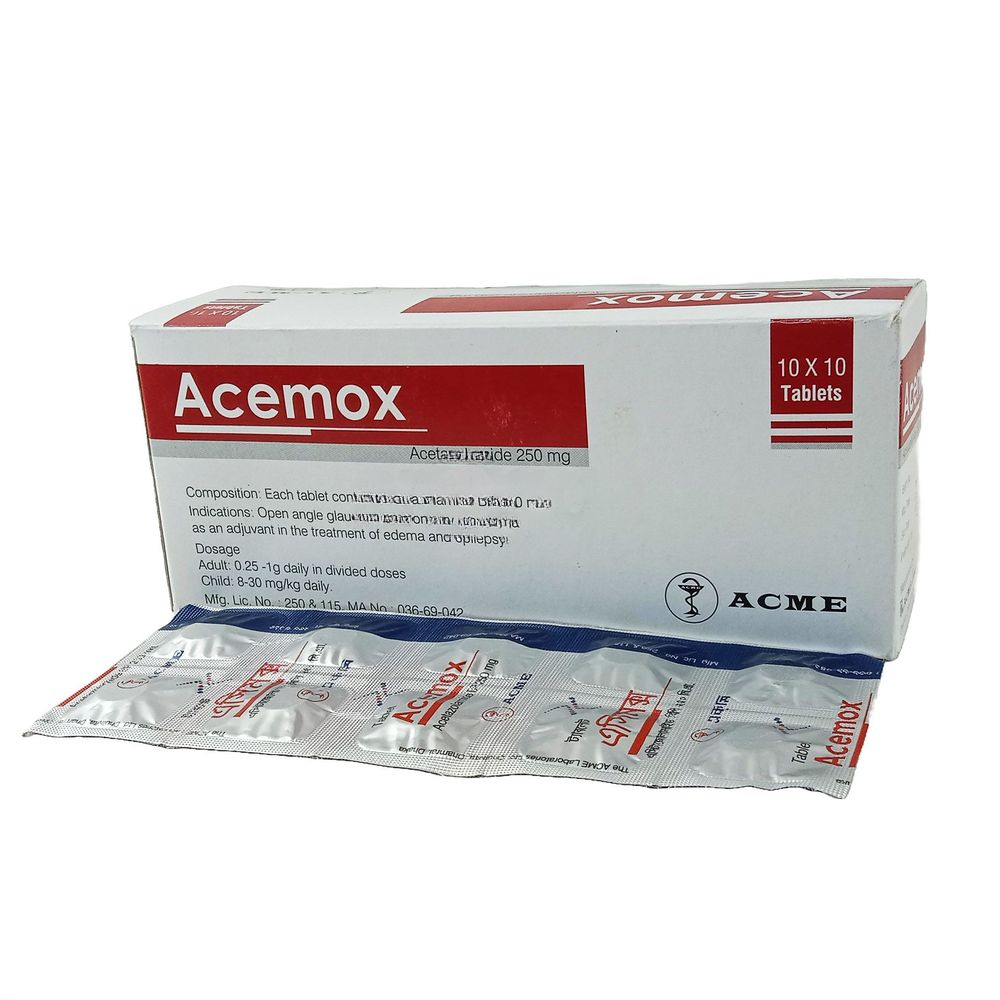
Take this medicine in the dose and duration as advised by your doctor. Swallow it as a whole. Do not chew, crush or break it. Acemox may be taken with or without food, but it is better to take it at a fixed time.
Acemox is a carbonic anhydrase inhibitor. It works in glaucoma by decreasing the production of aqueous humour (fluid in the eye), thereby lowering the increased eye pressure. It also acts on the kidneys to remove extra water and electrolytes through urine to relieve fluid retention and oedema (swelling). In epilepsy, it relieves seizures (fits) by stabilizing electrical activity in the brain.
If you miss a dose of Acemox, take it as soon as possible. However, if it is almost time for your next dose, skip the missed dose and go back to your regular schedule. Do not double the dose.
Acetazolamide is a potent medication belonging to a class of drugs known as carbonic anhydrase inhibitors. Unlike typical diuretics, it works by blocking a specific enzyme (carbonic anhydrase) in the body. This action helps reduce the production of certain fluids, such as the fluid in the eyes and the brain, and alters the balance of salt and water in the kidneys.
Acetazolamide is a versatile medication used for several distinct medical conditions:
Glaucoma: It reduces intraocular pressure by decreasing the production of aqueous humor (fluid in the eye). It is used for both open-angle and acute congestive (closed-angle) glaucoma.
Altitude Sickness (Mountain Sickness): It is used to prevent and reduce the symptoms of altitude sickness (such as headache, tiredness, and nausea) by helping the body acclimatize to high altitudes more quickly.
Edema (Fluid Retention): It acts as a mild diuretic to help the body get rid of extra water, especially in patients with congestive heart failure.
Epilepsy: It is sometimes used as an adjunct therapy to control certain types of seizures (specifically petit mal or unlocalized seizures).
Enzyme Inhibition: By inhibiting the carbonic anhydrase enzyme, the drug slows down the formation of hydrogen and bicarbonate ions.
In the Eyes: It lowers the rate of fluid secretion, which reduces pressure inside the eyeball.
In the Kidneys: It causes the kidneys to excrete more bicarbonate, sodium, and potassium, which leads to increased urine output and changes the acidity of the blood.
In the Brain: This change in blood acidity stimulates breathing, which is why it is effective for altitude sickness.
While taking Acetazolamide, some patients may experience:
Tingling Sensations: Numbness or a "pins and needles" feeling (paresthesia) in the fingers, toes, or lips.
Increased Urination: Due to its diuretic effect.
Taste Alterations: Specifically, carbonated beverages may taste "flat" or metallic.
Dizziness or Drowsiness: Especially when starting the medication.
Loss of Appetite or Nausea.
Allergies: People allergic to Sulfonamides (sulfa drugs) should avoid Acetazolamide, as it is a derivative of sulfa.
Hydration: It is important to drink plenty of fluids to prevent dehydration and kidney stones.
Chronic Conditions: Use with caution in patients with severe liver or kidney disease, or those with electrolyte imbalances (low sodium or potassium).
Driving: Since it can cause dizziness or blurred vision, caution is advised when driving or operating machinery.
Administration: It can be taken with or without food. If it causes stomach upset, taking it with food is recommended.
Timing: To avoid waking up in the middle of the night to urinate, it is best to take the last dose of the day in the late afternoon.
Consistency: Take the medication at the same time every day to maintain a steady level in the bloodstream.
