
Search products by name
Search medicines by name
0
0 item
৳ 0.00
Your Complete HealthCare Solution - Right Here


10657
info@shukhee.com
Telecom Bhaban (Level- 12), 53/1 Box Nagar, Zoo Road, Dhaka-1216.
৳ 0.00
10657
info@shukhee.com
Telecom Bhaban (Level- 12), 53/1 Box Nagar, Zoo Road, Dhaka-1216.


Quantity:

Products

Payment

Delivery
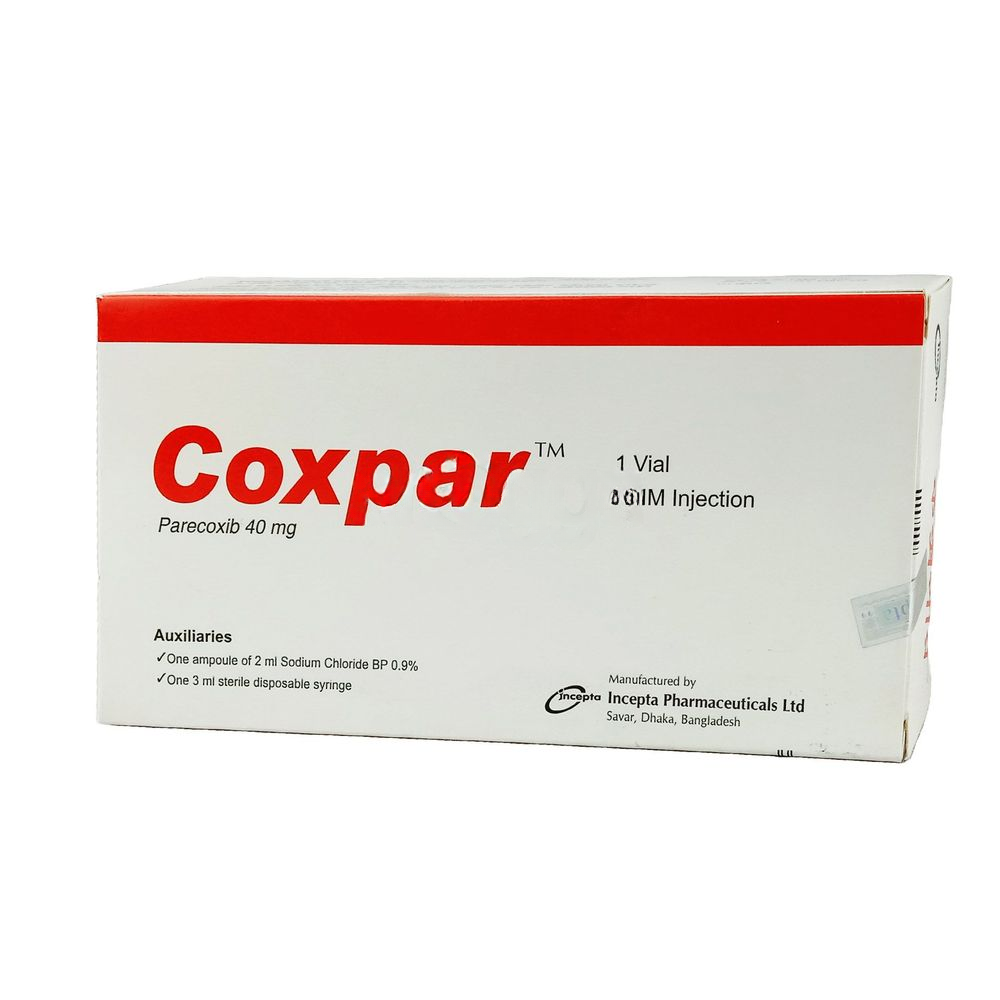
Indications
For the short-term treatment of postoperative pain in adults. The decision to prescribe a selective cyclooxygenase-2 (COX-2) inhibitor should be based on an assessment of the individual patient's
overall risks.
Pharmacology
Parecoxib is a prodrug of valdecoxib. Valdecoxib is a selective COX-2 inhibitor within the clinical dose range. Cyclooxygenase is responsible for generation of prostaglandins. Two isoforms, COX-1 and
COX-2, have been identified. COX-2 is the isoform of the enzyme that has been shown to be induced by pro-inflammatory stimuli and has been postulated to be primarily responsible for the synthesis of
prostanoid mediators of pain, inflammation, and fever. COX-2 is also involved in ovulation, implantation and closure of the ductus arteriosus, regulation of renal function, and central nervous system
functions (fever induction, pain perception and cognitive function). It may also play a role in ulcer healing. COX-2 has been identified in tissue around gastric ulcers in man but its relevance to ulcer
healing has not been established.
The difference in antiplatelet activity between some COX-1 inhibiting NSAIDs and COX-2 selective inhibitors may be of clinical significance in patients at risk of thrombo-embolic reactions. COX-2
selective inhibitors reduce the formation of systemic (and therefore possibly endothelial) prostacyclin without affecting platelet thromboxane. The clinical relevance of these observations has not been
established.
Dosage
Adult: The recommended dose is 40 mg administered intravenously (IV) or intramuscularly (IM), followed every 6 to 12 hours by 20 mg or 40 mg as required, not to exceed 80 mg/day. As the
cardiovascular risk of COX-2 specific inhibitors may increase with dose and duration of exposure, the shortest duration possible and the lowest effective daily dose should be used. There is limited
clinical experience with Parecoxib treatment beyond three days.
Elderly: No dose adjustment is generally necessary in elderly patients (265 years). However, for elderly patients weighing less than 50 kg, treatment should be initiated with half the usual recommended
dose of Parecoxib and reduce the maximum daily dose to 40 mg.
Children: The safety and efficacy of parecoxib in children under 18 years old have not been established. No data are available. Therefore, parecoxib is not recommended in these patients.
Administration
The IV bolus injection may be given rapidly and directly into a vein or into an existing IV line. The IM injection should be given slowly and deeply into the muscle. For instructions on reconstitution of the
medicinal product before administration. Precipitation may occur when Parecoxib is combined in solution with other medicinal products and therefore Parecoxib must not be mixed with any other
medicinal product, either during reconstitution or injection. In those patients where the same IV line is to be used to inject another medicinal product, the line must be adequately flushed prior to and
after Parecoxib injection with a solution of known compatibility.
Contraindications
Hypersensitivity to the active substance or to any of the excipients.
Side Effects
Commonside effects are-
. Change in your blood pressure (up or down)
You may get back pain
Ankles, legs and feet may swell (fluid retention)
You may feel numb- your skin may lose sensitivity to pain and touch
. You may get vomiting, stomach ache, indigestion, constipation, bloating and wind
. Tests may show abnormal kidney function
. You may feel agitated or find it hard to sleep
Dizziness
There is a risk of anaemia- changes in red blood cells after an operation that may cause fatigue and breathlessness
. You may get a sore throat or difficulty breathing (shortness of breath)
Your skin may be itchy
N/A
N/A