
Search products by name
Search medicines by name
0
0 item
৳ 0.00
Your Complete HealthCare Solution - Right Here


10657
info@shukhee.com
Telecom Bhaban (Level- 12), 53/1 Box Nagar, Zoo Road, Dhaka-1216.
৳ 0.00
10657
info@shukhee.com
Telecom Bhaban (Level- 12), 53/1 Box Nagar, Zoo Road, Dhaka-1216.


Quantity:

Products

Payment

Delivery
Female:
Ovulation induction in infertility due to anovulation or impaired follicle maturation
Preparation of follicles for puncture in controlled ovarian hyperstimulation (ART)
Luteal phase support
Threatened and habitual abortion
Male:
Hypogonadotropic hypogonadism (including idiopathic dysspermatogenesis)
Delayed puberty due to insufficient pituitary gonadotropin function
Cryptorchidism (not due to anatomical obstruction)
Oligospermia treatment
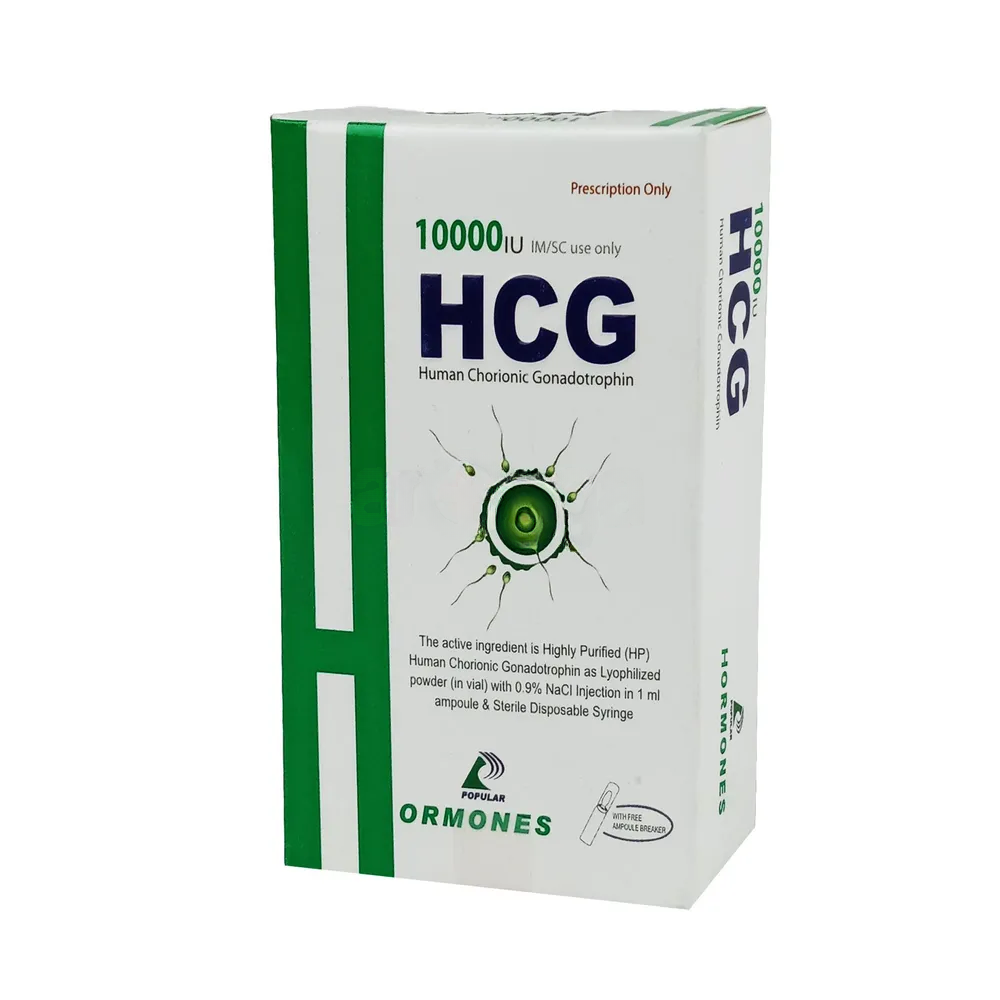
Highly purified HCG has LH activity, essential for gamete growth, maturation, and gonadal steroid production.
In females: substitutes endogenous LH surge to induce ovulation and supports luteal phase.
In males: stimulates Leydig cells to produce testosterone.
Plasma levels peak ~6 hours after injection; half‑life ~2 days; metabolized mainly in kidneys.
Female (Ovulation induction/follicle preparation): Single injection 5000–10,000 IU HCG after FSH treatment.
Luteal support: Two repeat injections of 2500–5000 IU within 9 days post ovulation/embryo transfer.
Threatened/habitual abortion: 5000 IU deep IM twice weekly until 7th week of gestation.
Male (Hypogonadotropic hypogonadism): 2500–5000 IU twice weekly; add FSH if infertility is main complaint. Continue ≥3 months. Suspend testosterone replacement during therapy.
No clinically relevant interactions known.
Known/suspected androgen‑dependent tumors (prostate, breast carcinoma in males).
Allergic reactions: local pain, rash, fever.
Female: Ovarian hyperstimulation syndrome (OHSS).
Male: Water/sodium retention due to excess androgen production.
Risk of aggravation in cardiac failure, renal dysfunction, hypertension, epilepsy, migraine.
In prepubertal boys: risk of premature epiphyseal closure or precocious puberty.
Pregnancy Category X: Contraindicated in pregnancy.
Contraindicated during lactation.
Risk of multiple births after ovulation induction.
OHSS risk with prior FSH treatment → monitor follicular growth and estradiol.
Avoid HCG if OHSS occurs.
Higher risk of ectopic pregnancy and pregnancy loss in ART.
Pediatric: May induce precocious puberty in cryptorchidism treatment.
Geriatric: Not studied in patients ≥65 years.
Very low acute toxicity; no known overdose symptoms.
Female sex hormones

Anovulatory infertility, Adjunct to IVF procedures and other assisted conception techniques
Intramuscular\r\nPrepubertal cryptorchidism in males\r\nAdult: 500-4000 u injected 3 times wkly. Treatment should continue for 1-2 mth after testicular descent.\r\n\r\nMale infertility due to hypogonadotrophic hypogonadism\r\nAdult: 500-4000 u injected 2-3 times wkly.\r\n\r\nAnovulatory infertility\r\nAdult: Single dose of 5000-10,000 u. Up to 3 repeated injections of up to 5000 u each may be given within the following 9 days to prevent corpus luteum insufficiency. \r\n\r\nDelayed puberty associated with hypogonadism in males\r\nAdult: Male: Initially, 500-1500 u twice a wk titrated against plasma-testosterone concentration.
Hypersensitivity; precocious puberty, prostatic carcinoma or other androgenic dependent neoplasm. Pregnancy and lactation.
Chorionic Gonadotrophin is a polypeptide hormone produced by the human placenta. It stimulates the production of gonadal steroid hormones by inducing interstitial cells (Leydig cells) of the testis to produce androgens and the corpus luteum of the ovary to produce progesterone.
Discontinue therapy if signs of precocious puberty are seen in patients treated for cryptorchidism. Patients with cardiac or renal disease, epilepsy, migraine or asthma.
Headache, irritability, restlessness, depression, fatigue, oedema; precocious puberty, gynaecomastia; pain at Inj site; enlargement of preexisting ovarian cysts and possible rupture; arterial thromboembolism; shock; abdominal pain.\r\n\r\nPotentially Fatal: Ovarian hyperstimulation syndrome (OHSS).
Interactions of Human chorionic gonadotrophin with other medicines have not been investigated; interactions with commonly used medicinal products cannot be excluded.\r\nFollowing administration, Human chorionic gonadotrophin may interfere for up to 10 days with the immunological determination of serum/urinary human chorionic gonadotropin (hCG), leading to a false positive pregnancy test.\r\n\r\nIncompatibilities: In the absence of compatibility studies, Pregnyl must not be mixed with other medicinal products.
N/A