
Search products by name
Search medicines by name
0
0 item
৳ 0.00
Your Complete HealthCare Solution - Right Here


10657
info@shukhee.com
Telecom Bhaban (Level- 12), 53/1 Box Nagar, Zoo Road, Dhaka-1216.
৳ 0.00
10657
info@shukhee.com
Telecom Bhaban (Level- 12), 53/1 Box Nagar, Zoo Road, Dhaka-1216.

Quantity:

Products

Payment

Delivery
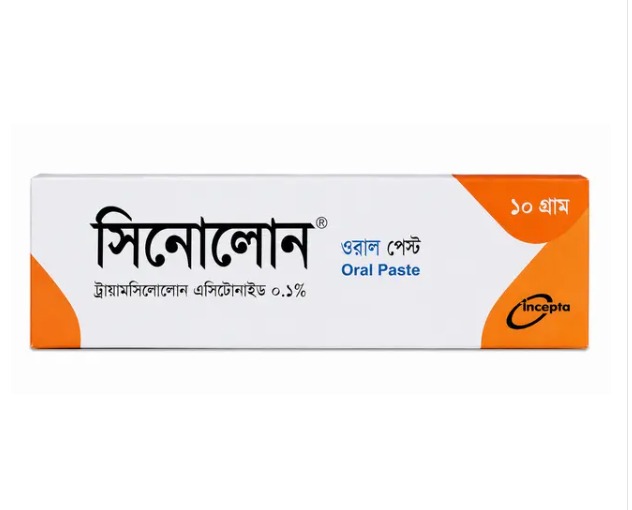
Adjunctive treatment and temporary relief of symptoms associated with oral inflammatory conditions.
Ulcerative lesions resulting from trauma.
Triamcinolone acetonide is a topical corticosteroid with anti-inflammatory, antipruritic, and vasoconstrictive properties.
Mechanism: Induces phospholipase A2 inhibitory proteins (lipocortins), which control biosynthesis of inflammatory mediators (prostaglandins, leukotrienes) by inhibiting release of arachidonic acid.
Apply a small dab (about ¼ inch) directly to the lesion until a thin film develops.
Do not rub in; spreading may cause gritty sensation.
Best applied at bedtime for prolonged contact.
May be applied 2–3 times daily, preferably after meals.
If no improvement within 7 days, further investigation is advised.
Hypersensitivity to any component.
Presence of fungal, viral, or bacterial infection of the mouth or throat.
Local reactions: burning, itching, irritation, dryness, blistering, peeling, perioral dermatitis, allergic contact dermatitis, maceration, secondary infection, oral mucosa atrophy.
Pregnancy Category D. Shown to cause teratogenic effects in animals.
Unknown if sufficient systemic absorption occurs to affect breast milk.
Use with caution in nursing women.
Discontinue if local adverse reactions occur.
Allergic contact sensitization may present as failure to heal.
If mucosal infections are present, use appropriate antifungal/antibacterial agents.
Prolonged use may cause systemic absorption → HPA axis suppression, Cushing’s syndrome, hyperglycemia, glucosuria.
Monitor patients on prolonged therapy.
Pediatric patients: greater susceptibility to HPA suppression and growth interference.
Geriatric patients: no significant differences reported compared to younger adults.
Corticosteroid, Glucocorticoid
Mouth ulceration
Mouth/Throat\r\nMouth ulceration\r\nAdult: A small amount (about 0.6 cm) of the 0.1% paste is pressed onto the lesion without rubbing until a thin film develops. \r\nApply 2 or 3 times daily, preferably after meals. \r\nRe-evaluate if recovery does not occur after 7 days of treatment.
Untreated systemic fungal, bacterial, viral or parasitic infection, hypersensitivity.
Triamcinolone has mainly glucocorticoid activity. It suppresses the migration of polymorphonuclear leukocytes and reduces capillary permeability thereby decreasing inflammation.
Diabetes; hypertension, renal and liver impairment; glaucoma; psychosis; delayed tissue healing; cirrhosis; heart failure; recent MI; hypothyroidism; osteoporosis; peptic ulceration; thromboembolic disorders. Monitor height in children on prolonged therapy. Avoid rapid drug withdrawal. Elderly, children, pregnancy, lactation.
Local burning, itching, irritation, GI upsets; increased fragility of mucosa of the mouth.
Lowering of plasma salicylates levels. Increased risk of GI bleeding and ulceration with NSAIDs. Antagonised blood glucose-lowering effects of the antidiabetics. Increased risk of hyperkalaemia with amphotericin B, beta agonists, beta-blockers, potassium-depleting diuretics, theophylline. Increased clearance of the triamcinolone with ciclosporin, carbamazepine, phenytoin, barbiturate, rifampicin. Infections may develop if given with live vaccines.

N/A