
Search products by name
Search medicines by name
0
0 item
৳ 0.00
Your Complete HealthCare Solution - Right Here


10657
info@shukhee.com
Telecom Bhaban (Level- 12), 53/1 Box Nagar, Zoo Road, Dhaka-1216.
৳ 0.00
10657
info@shukhee.com
Telecom Bhaban (Level- 12), 53/1 Box Nagar, Zoo Road, Dhaka-1216.


Quantity:

Products

Payment

Delivery
Indications
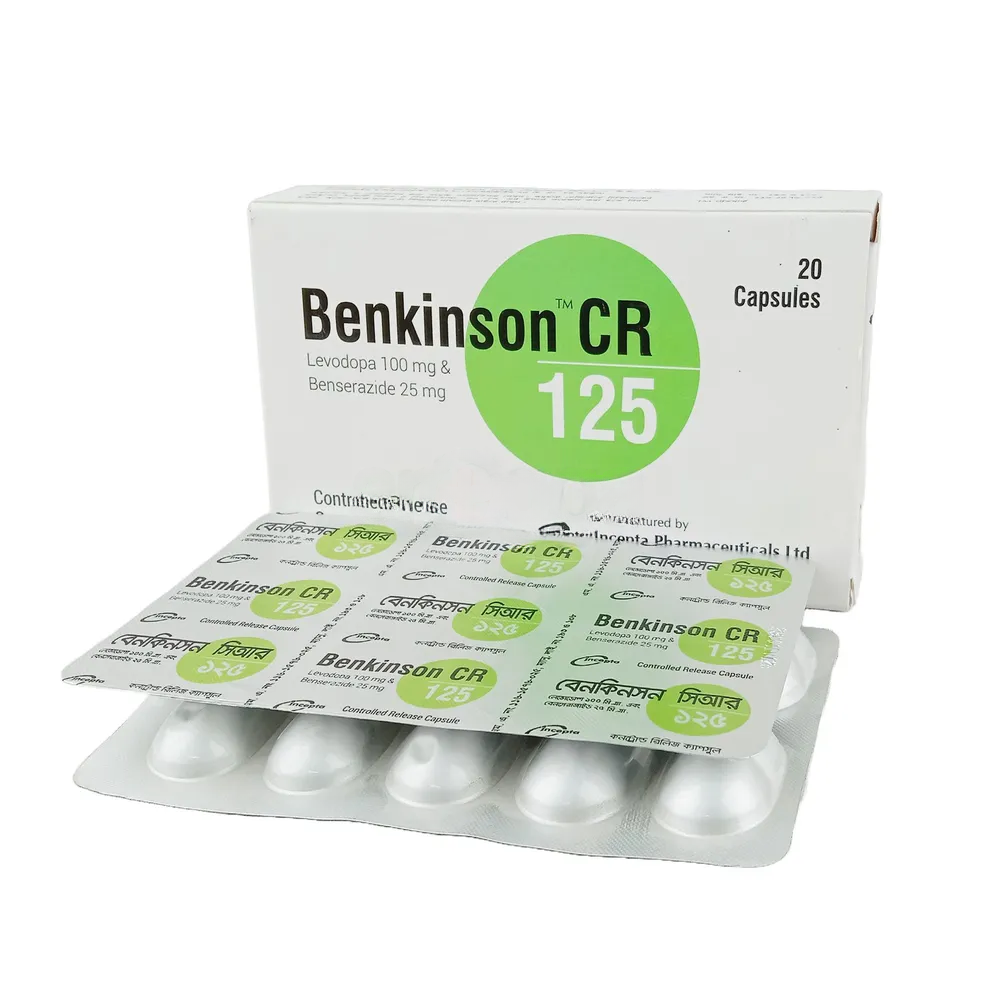
Immediate release capsule: Treatment of all forms of Parkinson’s syndrome except medicine-induced Parkinsonism.
Controlled release capsule: For patients with motor fluctuations related to plasma level changes (e.g., “peak dose dyskinesia,” “end of dose deterioration”) and better control of nocturnal symptoms.
Pharmacology Levodopa is a dopamine precursor that crosses the blood–brain barrier, unlike dopamine itself. In the CNS, it is converted to dopamine by aromatic L-amino acid decarboxylase. Peripheral conversion causes side effects and reduces availability to basal ganglia. Benserazide, a peripheral decarboxylase inhibitor, prevents this peripheral metabolism. The optimal ratio of levodopa to benserazide is 4:1, proven effective in trials.
Dosage & Administration
Immediate Release (IR):
Early stage: 62.5 mg (50+12.5) 1–2 times/day; increase gradually every 3–4 days.
Patients not on levodopa: 62.5 mg 3–4 times/day; maintenance 125 mg (100+25) 3–6 times/day.
Advanced stage: Adjust based on prior levodopa therapy.
Controlled Release (CR):
Initial: 125 mg (100+25) 3 times/day; substitute each 100 mg levodopa with 1 CR capsule.
Increase every 2–3 days according to response.
Maximum: 6 capsules/day.
Renal impairment: No dose reduction needed in mild/moderate cases.
Hepatic impairment: Safety not established.
Interactions
Neuroleptics, opioids, antihypertensives with reserpine inhibit action.
Avoid concomitant sympathomimetics (adrenaline, noradrenaline, isoproterenol, amphetamine). If necessary, monitor cardiovascular system closely.
Antipsychotics with D2 receptor antagonism may reduce efficacy.
Discontinue 12–48 hours before surgery requiring halothane anesthesia.
Contraindications
Hypersensitivity to levodopa–benserazide or excipients.
Non-selective MAO inhibitors (risk of hypertensive crisis).
Decompensated endocrine, renal, hepatic, cardiac disorders.
Psychiatric diseases with psychotic component.
Closed-angle glaucoma.
History of melanoma or suspicious lesions.
Intention tremor, Huntington’s chorea.
Patients <30 years old (skeletal development must be complete).
Side Effects Anxiety, decreased appetite, arrhythmia, depression, diarrhea, hallucination, movement disorders, nausea, postural hypotension, sleep disorders, altered taste, vomiting, leucopenia.
Pregnancy & Lactation
Pregnancy Category B3: Contraindicated during pregnancy and in women of childbearing potential without contraception.
Discontinue if pregnancy occurs.
Safety during lactation not established.
Use in Children Contraindicated in patients <30 years old.
Precautions & Warnings Use with caution in patients with: Cushing’s syndrome, diabetes, endocrine disorders, convulsions, myocardial infarction with arrhythmia, peptic ulcer, hyperthyroidism, osteomalacia, pheochromocytoma, psychiatric illness, severe cardiovascular/pulmonary disease, angle-closure glaucoma.
Overdose Effects Monitor vital signs and provide supportive care. Treat cardiovascular effects (antiarrhythmics) or CNS effects (respiratory stimulants, neuroleptics). For CR formulation, prevent further absorption.
N/A
N/A