Search products by name
Search medicines by name
0
0 item
৳ ০.০০
আপনার সব স্বাস্থ্যসেবার সমাধান — এখন এক জায়গাতেই


১০৬৫৭
info@shukhee.com
টেলিকম ভবন, ৫৩/১, বক্স নগর, ঢাকা-১২১৬
৳ ০.০০
১০৬৫৭
info@shukhee.com
টেলিকম ভবন, ৫৩/১, বক্স নগর, ঢাকা-১২১৬


Quantity:

Products

Payment

Delivery
Female:
Sterility in women with hypo‑ or normogonadotropic ovarian insufficiency
Stimulation of follicle growth
Male:
Sterility in men with hypo‑ or normogonadotropic hypogonadism (in combination with HCG to stimulate spermatogenesis)
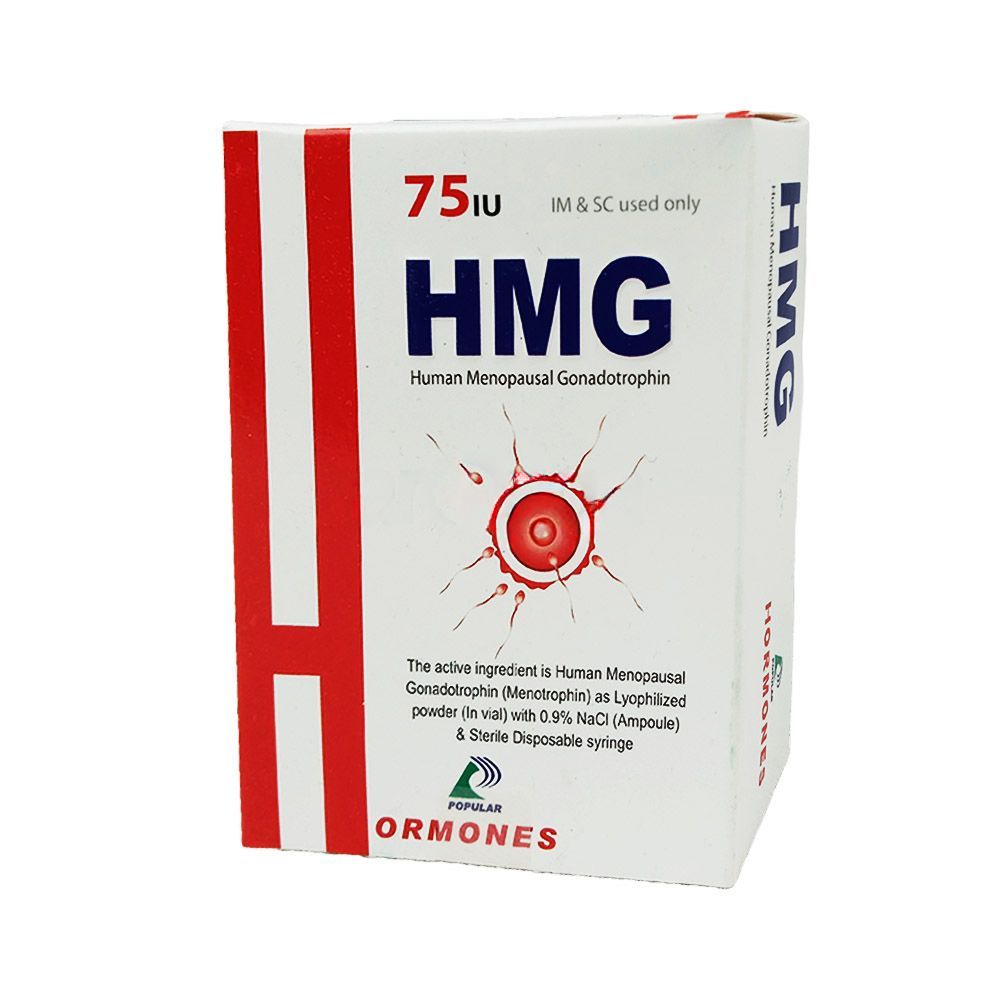
Pharmacodynamics: HMG acts directly on ovaries and testes.
In ovaries: FSH component increases follicle growth and estradiol production; LH component stimulates theca cells.
In testes: FSH promotes maturation of seminiferous tubules and spermatogenesis (requires prior HCG treatment for adequate androgen levels).
Pharmacokinetics:
IM injection: peak FSH serum level in 6–10 hours; half‑life ~50 hours.
SC injection: peak in 6–8 hours; half‑life ~51 hours.
Excreted mainly renally.
Female sterility: Start 75–150 IU FSH daily IM/SC. Adjust based on ovarian response (ultrasound, estradiol). Continue until pre‑ovulatory estradiol level achieved. Ovulation induced with 5000–10,000 IU HCG 1–2 days after last HMG dose.
Male sterility: Initially HCG 5000 IU twice weekly until testosterone normalizes. Then add HMG (5 × 75–150 IU FSH + 75–150 IU LH weekly) for several months.
IM or SC injection.
Patient selection requires thorough gynecological/endocrinological evaluation in women; pituitary function assessment in men.
Unknown; HMG can be combined with HCG in male infertility treatment.
Female:
Pregnancy
Ovarian enlargement/cysts not due to PCOS
Undiagnosed gynecological bleeding
Tumors of uterus, ovaries, breast
Hypersensitivity to HMG/excipients
High FSH indicating primary ovarian failure
Uncontrolled thyroid/adrenal dysfunction
Infertility causes other than anovulation
Male:
Prostate carcinoma
Testicular tumors
Normal gonadotropin levels (normal pituitary function)
Elevated gonadotropins (primary testicular failure)
Infertility causes other than hypogonadotropic hypogonadism
Contraindicated during pregnancy and lactation.
Risk of miscarriage, multiple births, ectopic pregnancy after ovulation induction.
Monitor ovarian activity (ultrasound, estradiol) every 1–2 days.
Discontinue immediately if unintended hyperstimulation occurs.
Severe OHSS may be life‑threatening (large cysts, ascites, hydrothorax, thromboembolism).
Excessive dose may cause ovarian hyperstimulation.
Mild cases: monitor and symptomatic treatment.
Severe cases: hospitalization, IV fluids, monitoring for thromboembolism.
Female sex hormones

Female infertility, Male infertility, In vitro fertilisation procedures or other assisted conception techniques
$4e
Ovarian cysts or enlargement not caused by polycystic ovarian syndrome; tumors of breast, uterus, ovaries, testes or prostate; vaginal bleeding of unknown cause; pregnancy and lactation.
Human menopausal gonadotrophins possess both follicle-stimulating hormone (FSH) and luteinizing hormone (LH) activities.
Hyperprolactinemia or tumors of the pituitary or hypothalamus. Ovarian enlargement at risk of rupture, care in pelvic examinations. Risk of multiple births.
Ovarian hyperstimulation, risk of multiple pregnancy and miscarriage, hypersensitivity and local reactions at Inj site, nausea, vomiting, joint pain, fever. In men, gynecomastia, acne, weight gain.\r\nPotentially Fatal: Rupture of ovarian cysts and intraperitoneal haemorrhage.
Drugs with luteinising hormone activity may increase risk of ovarian hyperstimulation syndrome.
N/A