Search products by name
Search medicines by name
0
0 item
৳ ০.০০
আপনার সব স্বাস্থ্যসেবার সমাধান — এখন এক জায়গাতেই


১০৬৫৭
info@shukhee.com
টেলিকম ভবন, ৫৩/১, বক্স নগর, ঢাকা-১২১৬
৳ ০.০০
১০৬৫৭
info@shukhee.com
টেলিকম ভবন, ৫৩/১, বক্স নগর, ঢাকা-১২১৬


Products

Payment

Delivery
Indications
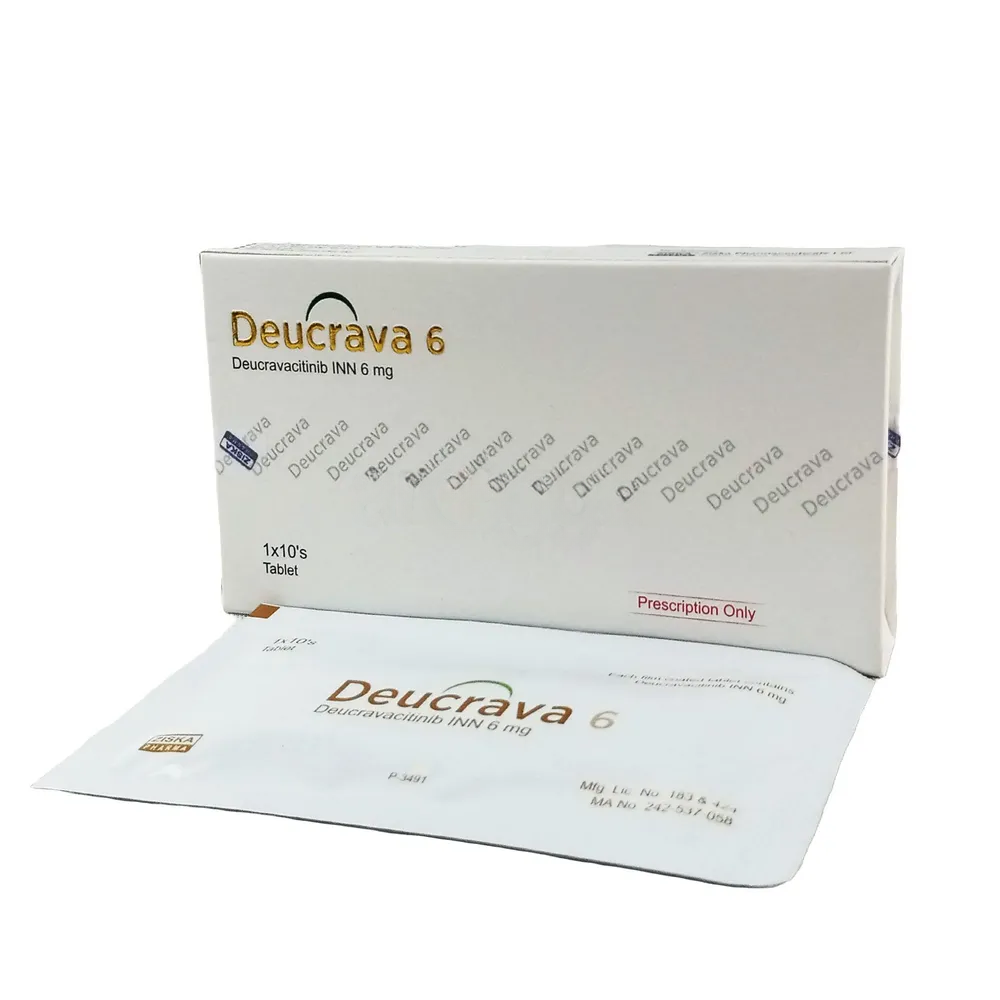
Deucrava is indicated for the treatment of moderate-to-severe plaque psoriasis in adults who are candidates for systemie therapy or phototherapy. Deucrava is not recommended for use in combination with
other potent immunosuppressants.
Pharmacology
Doucravacitinib is an inhibitor of tyrosine kinase 2 (TYK2). TYK2 is a member of the Janus kinase (JAK) family. Doucravacitinib binds to the regulatory domain of TYK2, stabilizing an inhibitory interaction betwoen
the regulatory and the catalytic domains of the enzyme. This results in allosteric inhibition of receptor-mediated activation of TYK2 and its downstream activation of Signal Transducers and Activators of
Transcription [STATs) as shown in coll-based assays. JAK kinases, including TYK2, function as pairs of homo- or heterodimers in the JAK-STAT pathways. TYK2 pairs with JAK1 to mediate multiple cytokino
pathways and also pairs with JAK2 to transmit signals as shown in cell-based assays. The precise mechanism linking inhibition of TYK2 enzyme to therapeutic effectiveness in the treatment of adults with
moderate-to-severe plaque psoriasis is not currently known.
Dosage & Administration
Recommended Evaluations and Immunizations Prior to Treatment Initiation: Evaluate patients for active and latent tuberculosis (TB) infection prior to initiating treatment with Doucravacitinib. If positive,
start treatment for TB prior to Doucravacitinib.
Recommended Dosage: The recommended dosage of Doucravacitinib is 6 mg taken orally once daily, with or without food. Do not crush, out, or chew the tablets.
Pediatric Use: The satety and effectiveness in pediatrie patients have not been established.
Geriatric Use: No overall differences in effectiveness have boen observed betwoen patients 65 yoars of age and older and younger adult patients.
Recommended Dosage in Patients with Hepatie Impairment: Doucravacitinib is not recommended in patients with severe hepatic impairment (Child-Pugh C). No dosage adjustment is needed for patients with
mild to moderate hepatic impairment.
Renal Impairment: No dose adjustment is recommended in patients with mild, moderate, or severe renal impairment or in patients with end stage renal disease (ESRD) on dialysis.
*(जर फोई सिकद माकन जाम्म (मासाजक अषय एवन कशन
Interaction
Clinical Trials: No clinically significant differences in the pharmacokinatics of Deucrava were observed when co-administered with the following drugs Cyclosporine (dual Pgp/BCRP inhibitor], fluvoxamine
(CYP1A2 inhibitor), ritonavir (CYP142 inducer), diffunisal (UGT 1A9 inhibitor), pyrimethamine [OCT1 inhibitor), famotidine (H2 receptor antagonist), or rabeprazole (proton pump inhibitor). No clinically signicant
differences in the pharmacokinetics of the following drugs were observed when co-administered with Deucrava: Rosuvastatin, methotrexate, mycophenolate mofetil [MMF) and oral contraceptives
(norethindrone acetate and ethinyl estradiol).
Contraindications
Doucravacitinib is contraindicated in patients with a history of hypersensitivity reaction to Doucravacitinib or to any of the excipients of this preparation.
Side Effects
The most common side effect of Deucrava include common cold, sore throat, and sinus infection (upper respiratory infections), cold sores (herpes simplex), sores on inner lips, gums, tongue, or root of the mouth
(oanker sores), inflamed hair pores (folliculitis), acne. It may cause serious allergie reactions including feeling faint or swelling in the face, eyelids, lips, mouth, tongue, or throat, trouble breathing or throat
tightness or chest tightness or skin rash, hives etc.
Pregnancy & Lactation
Available data from case reports on Deucravacitinib use during pregnancy are insutficient to evaluate a drug-associated risk ol major birth defects, miscarriage. or adverse materal or fetal outcomes. No efffect
on embryo-fetal development were seen in animal reproductive studies. There are no data on the presence of Deucravacitinib in human milk, the effects on the breastfed infant, or the effects on milk production.
The developmental and health benefts of broastfeeding should be considered along with the mother's clinical need for Deucravacitinib and any potential adverse effects on the breastfed infant from
Deucravacitinib.
Precautions & Warnings
Hypersensitivity: Hypersensitivity reactions such as angioedema have been reported. Discontinue if a clinically significant hypersensitivity raction occurs.
Infections: Deucrava may increase the risk of infection. Avoid use in patients with active or serious infection. If a serious infection develops, discontinue this until the infection resolves.
Tubereulosis: Evaluate for TB prior to initiating treatment with Doucrava.
Maliignancy: Malignancies including lymphomas were observed in clinical trials with Deucrava.
Laboratory Abnormalities: Poriodically evaluate serum triglycerides. Evaluate liver enzymes at baseline and thereafter in patients with known or suspected liver disease.





Deucravacitinib is an oral selective tyrosine kinase 2 (TYK2) inhibitor. It is approved for the treatment of moderate-to-severe plaque psoriasis in adults. It represents a new class of targeted therapy distinct from traditional JAK inhibitors.
Selective TYK2 inhibitor (oral small molecule).
Used to treat moderate-to-severe plaque psoriasis in adults who are candidates for systemic therapy or phototherapy.
Selectively inhibits TYK2, a key enzyme in cytokine signaling pathways.
Blocks signaling of interleukin-23, interleukin-12, and type I interferons.
Reduces inflammation and abnormal immune activity in psoriasis.
First-in-class oral TYK2 inhibitor.
More selective than JAK inhibitors → potentially fewer side effects.
Convenient oral dosing compared to injectable biologics.
Demonstrated efficacy in improving skin clearance and quality of life.
Oral tablets: 6 mg once daily.
Dose may vary based on physician’s advice and patient’s condiTION
Improves skin lesions in plaque psoriasis.
Reduces itching, scaling, and redness.
Convenient oral administration.
Effective alternative for patients not responding to other therapies.
Pregnancy: Limited data; use only if clearly needed under medical supervision. Children: Safety and efficacy not established. Lactation: Unknown if excreted in breast milk; caution advised. Drug Interactions:
Metabolized via CYP enzymes; caution with strong inducers or inhibitors.
Monitor with immunosuppressants or biologics. Overdose:
Symptoms: headache, gastrointestinal upset, possible immune suppression.
Management: supportive care, monitor patient closely.