Search products by name
Search medicines by name
0
0 item
৳ ০.০০
আপনার সব স্বাস্থ্যসেবার সমাধান — এখন এক জায়গাতেই


১০৬৫৭
info@shukhee.com
টেলিকম ভবন, ৫৩/১, বক্স নগর, ঢাকা-১২১৬
৳ ০.০০
১০৬৫৭
info@shukhee.com
টেলিকম ভবন, ৫৩/১, বক্স নগর, ঢাকা-১২১৬

Quantity:

Products

Payment

Delivery
Indications
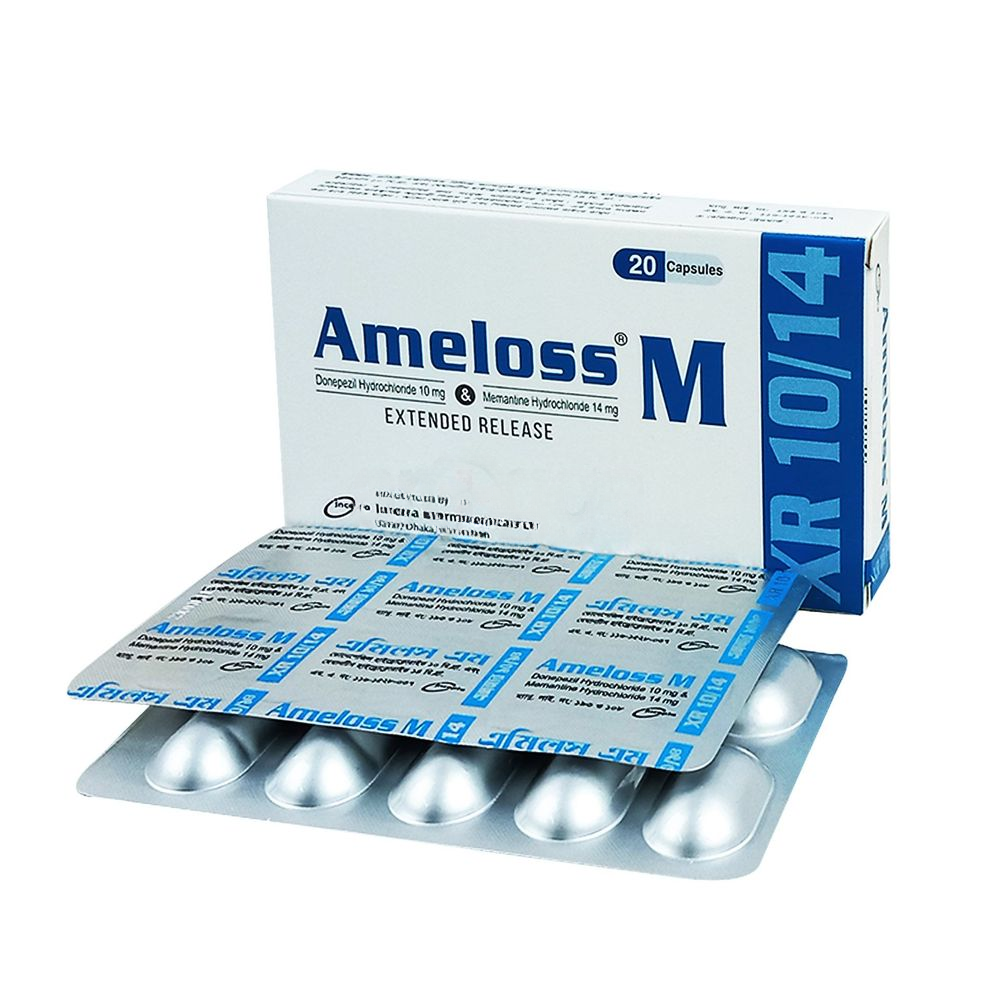
Memantine and donepezil hydrochlorides extended-release capsules are a combination of memantine hydrochloride, an NMDA receptor antagonist, and donepezil hydrochloride, an
acetylcholinesterase inhibitor, indicated for the treatment of moderate to severe dementia of the Alzheimer's type in patients stabilized on 10 mg of donepezil hydrochloride once daily.
Composition
7/10 Capsule: Each Extended Release Capsule contains Memantine Hydrochloride (as Extended Release Pellets) 7 mg & Donepezil Hydrochloride (as Immediate Release Pellets) 10 mg.
14/10 Capsule: Each Extended Release Capsule contains Memantine Hydrochloride (as Extended Release Pellets) 14 mg & Donepezil Hydrochloride (as Immediate Release Pellets) 10 mg.
21/10 Capsule: Each Extended Release Capsule contains Memantine Hydrochloride (as Extended Release Pellets) 21 mg & Donepezil Hydrochloride (as Immediate Release Pellets) 10 mg.
28/10 Capsule: Each Extended Release Capsule contains Memantine Hydrochloride (as Extended Release Pellets) 28 mg & Donepezil Hydrochloride (as Immediate Release Pellets) 10 mg.
Pharmacology
Memantine and donepezil hydrochlorides extended-release capsules contain two approved medications: memantine hydrochloride extended-release and donepezil hydrochloride. Each of those
medications is postulated to have a different mechanism in Alzheimer's disease.
Memantine: Persistent activation of central nervous system NMDA receptors by the excitatory amino acid glutamate has been hypothesized to contribute to the symptomatology of Alzheimer's
disease. Memantine is postulated to exert its therapeutic effect through its action as a low to moderate affinity uncompetitive (open channel) NMDA receptor antagonist which binds preferentially to the
NMDA receptor-operated cation channels. There is no evidence that memantine prevents or slows neurodegeneration in patients with Alzheimer's disease.
Donepezil: Current theories on the pathogenesis of the cognitive signs and symptoms of Alzheimer's disease attribute some of them to a deficiency of cholinergic neurotransmission. Donepezil is
postulated to exert its therapeutic effect by enhancing cholinergic function. This is accomplished by increasing the concentration of acetylcholine in the central nervous system through reversible
inhibition of its hydrolysis by acetylcholinesterase. There is no evidence that donepezil prevents or slows neurodegeneration in patients with Alzheimer's disease.
Dosage & Administration
For patients on donepezil hydrochloride 10 mg only, the recommended starting dose of memantine and donepezil hydrochlorides extended-release capsules is 7 mg/10 mg, taken once daily in the
evening. The dose should be increased in 7 mg increments to the recommended maintenance dose of 28 mg/10 mg. The minimum recommended interval between dose increases is one week.
Patients on memantine hydrochloride (10 mg twice daily or 28 mg extended-release once daily) and donepezil hydrochloride 10 mg once daily can be switched to memantine and donepezil
hydrochlorides extended- release capsules 28 mg/10 mg, taken once daily in the evening.
Memantine and donepezil hydrochlorides extended- release capsules can be taken with or without food, whole or sprinkled on applesauce; do not divide, chew, or crush. Severe renal impairment: the
recommended maintenance dose for memantine and donepezil hydrochlorides extended-release capsules is 14 mg/10 mg once daily in the evening.
Interaction
Combined use with NMDA antagonists: use with caution. Memantine and donepezil hydrochlorides extended-release may interfere with anticholinergic medications. Concomitant administration of
succinylcholine, similar neuromuscular blocking agents, or cholinergic agonists may lead to synergistic effect.
Contraindications
Memantine and donepezil hydrochlorides extended-release capsules are contraindicated in patients with known hypersensitivity to memantine hydrochloride, donepezil hydrochloride, piperidine
derivatives, or to any excipients used in the formulation.
Side Effects
The most common adverse reactions, occurring at a frequency of at least 5% and greater than placebo with memantine hydrochloride extended-release 28 mg/day, were headache, diarrhea, and
dizziness. The most common adverse reactions occurring at a frequency of at least 5% in patients receiving donepezil and at twice or more the placebo rate, include diarrhea, anorexia, vomiting,
nausea, and ecchymosis.
N/A
N/A