Search products by name
Search medicines by name
0
0 item
৳ ০.০০
আপনার সব স্বাস্থ্যসেবার সমাধান — এখন এক জায়গাতেই


১০৬৫৭
info@shukhee.com
টেলিকম ভবন, ৫৩/১, বক্স নগর, ঢাকা-১২১৬
৳ ০.০০
১০৬৫৭
info@shukhee.com
টেলিকম ভবন, ৫৩/১, বক্স নগর, ঢাকা-১২১৬


Products

Payment

Delivery
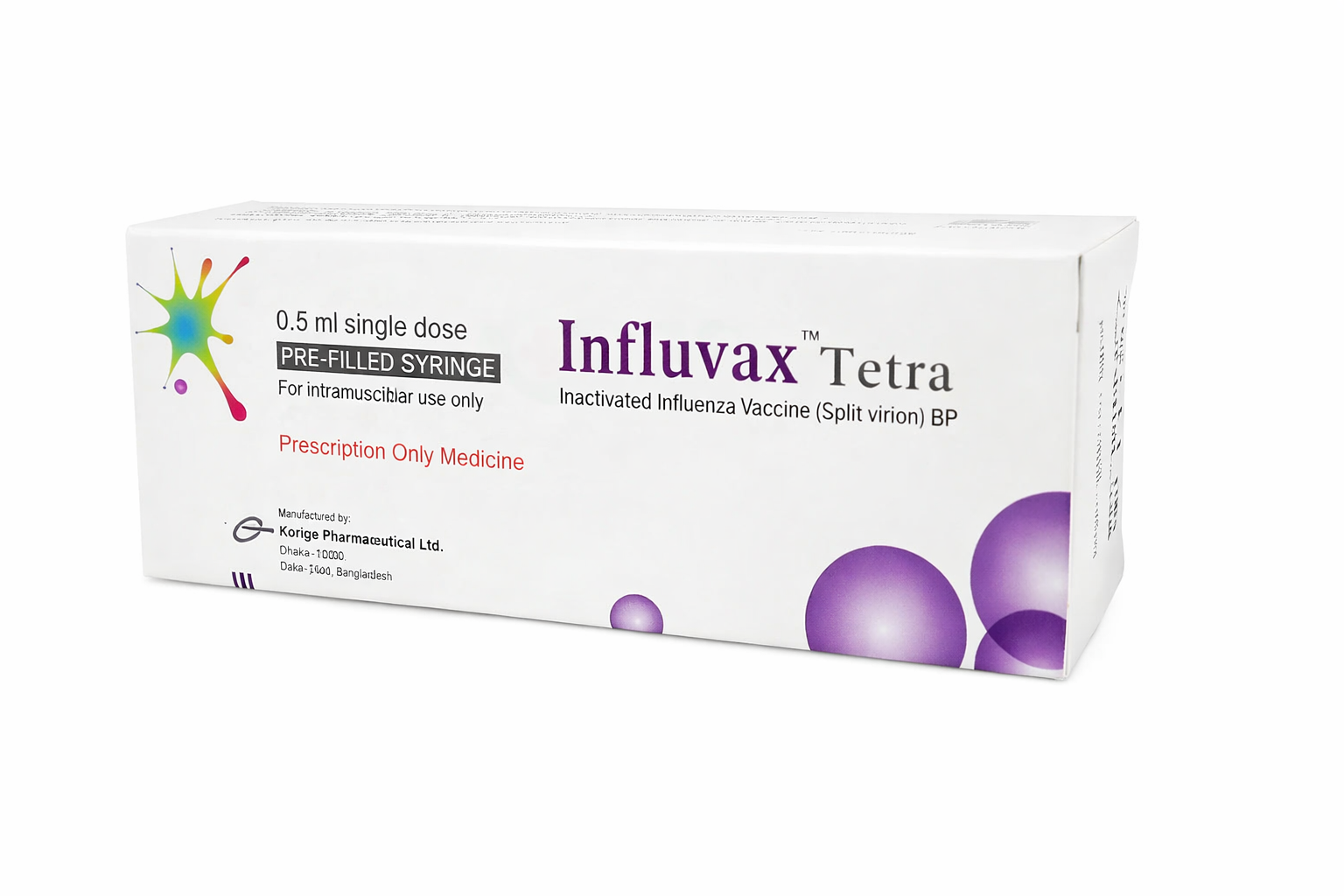
Influvax™ Tetra – Inactivated Influenza Vaccine (Split Virion) BP Indication: Recommended for adults and children aged 6 months and above, especially those at high risk of influenza complications — including children, elderly individuals, and people living in epidemic-prone areas. The vaccine stimulates the body’s immune response against influenza virus, helping prevent infection.
Administration: Intramuscular injection (IM) on the deltoid. Should be administered before the influenza season or as required by epidemiological conditions. Annual vaccination is recommended with an updated antigen composition.
Dosage:
Adults: 0.5 mL IM once yearly.
Children (3 years and above): 0.5 mL IM once yearly.
Children (6–36 months): 0.25 mL IM once yearly.
Children <9 years not previously vaccinated: A second dose after ≥4 weeks.
Contraindications: Hypersensitivity to egg/chicken proteins or any component of the vaccine (formaldehyde, octoxinol 9, neomycin). Avoid vaccination during acute or febrile illness.
Mode of Action: Induces specific antibody formation against influenza virus, promoting immunity.
Precautions: Use cautiously in individuals sensitive to formaldehyde, octoxinol 9, or neomycin. Patients with a history of Guillain-Barré Syndrome may have increased risk.
Pregnancy & Lactation: Safety not fully established; benefits should outweigh risks. As an inactivated vaccine, it lacks the theoretical risks of live vaccines.
Breastfeeding: Unknown if excreted in milk; use with caution.
Side Effects:
Local: Redness, swelling, pain, induration.
Systemic: Fever, malaise, fatigue, headache, muscle/joint pain — usually resolve within 1–2 days.
Rare: Neuralgia, paresthesia, convulsions, thrombocytopenia, allergic shock, vasculitis with transient renal involvement.
Pregnancy Category: Use only if clearly needed; benefits should outweigh potential risks.
Drug Interactions: Immunosuppressants, antineoplastics, or high-dose corticosteroids may reduce vaccine response. Aldesleukin and aspirin may increase antibody response; may enhance anticoagulant effect of warfarin.
Therapeutic Class: Vaccines, Anti-sera & Immunoglobulin



Vaccine is recommended for adults and children from six months and above, especially those having high risk of associated complications, such as children, senior citizens, those who are susceptible and those who are in influenza epidemic areas. \r\nThe vaccine can induce body to generate immunoreaction against influenza virus and can be used for prevention of infection caused by, influenza virus.
Intramuscular injection (IM) on deltoid.\r\nThis vaccine should be administered before the beginning of the influenza season or as required by the epidemiological situation. \r\nVaccination should be repeated every year with an age-appropriate dose of vaccine of updated antigen composition.\r\n
Intramuscular\r\nAdult: \r\nOne dose of 0.5 ml. every year.\r\n
Intramuscular\r\nChildren over 3 years of age: one dose of 0.5 ml. every year.\r\nChildren from 6 to 36 months of age: 1 dose of 0.25 ml. every year.\r\n\r\nFor Children <9 years who have not previously been vaccinated: a 2nd dose should be given after an interval of at least 4 weeks.\r\n\r\n
Known anaphylactic hypersensitivity reactions to egg proteins (eggs or egg products), chicken proteins, or any other component of the vaccine including traces (formaldehyde, octoxinol 9 (Triton X-100) and neomycin).\r\nImmunisation should not be performed during a febrile or acute illness. \r\n\r\n
Influenza virus vaccine inactivated promotes immunity to influenza virus by inducing specific antibody formation.
Since this vaccine contains traces of formaldehyde, octoxinol 9 (Triton X-100) and neomycin due to the use of these substances during production, it should be used with caution in subjects with a hypersensitivity to any of these substances.\r\nPatients with a history of Guillain-Barré Syndrome (GBS) with an onset related in time to influenza vaccination may be at increased risk of again developing GBS if given influenza vaccine.\r\n\r\nUse in pregnancy & lactation: Safety of use during pregnancy has not been established; benefits of vaccination should be weighed against potential risks. However, as an inactivated vaccine, it does not share the theoretical risks associated with live vaccines. \r\n\r\nIt is not known if this is excreted in human milk; hence, caution should used when administering vaccine to breastfeed ing women. However, as an inactivated vaccine, it does not share the theoretical risks associated with live vaccines.
In children under 5 years of age, systemic reactions (e.g. fever, malaise, myalgia) may be more pronounced. \r\nLocal Reactions: Erythema (redness), swelling, pain, ecchymosis, induration.\r\n\r\nSystemic Reactions: Fever, malaise, shivering, fatigue, headache, sweating, joint and muscular pain. These reactions usually disappear within 1-2 days without treatment.\r\n\r\nRarely: Neuralgia, paresthesia, convulsions and transient thrombocytopenia Allergic reactions leading to shock in rare cases. Vasculitis with transient renal involvement, in very rare cases.\r\n\r\n
Use in pregnancy: Safety of use during pregnancy has not been established; benefits of vaccination should be weighed against potential risks. However, as an inactivated vaccine, it does not share the theoretical risks associated with live vaccines.
Immunosuppressants, antineoplastics or high doses of corticosteroids may reduce response to vaccines. Increased antibody response with aldesleukin and aspirin. May possibly increase anticoagulant effects of warfarin.
N/A